Own the Solution,
Not the Problem
How sovereign capital can secure food, durable carbon removal and real assets in one move, on land that is contributed rather than bought.
You steward a nation’s wealth for generations. Three risks now land on your desk at once.
of the food Gulf states eat is imported. Every disruption to shipping, weather or trade becomes a national security event.
Supply-chain (Scope 3) emissions average 26 times a company’s own operations. Your portfolio companies own this problem, and so do you.
Only about half of the durable carbon-removal supply projected for 2026 is still unreserved. The best tonnes are being locked up now.
Food, climate and real assets are usually three mandates, three teams and three checks. None of them, on its own, compounds. Without a new structure, your fund keeps paying for the problem rather than owning the solution.
mOrganic Holdings is a Hawaiʻi-rooted regenerative agroforestry, superfoods and carbon-removal company. We turn working land into Regenerative Infrastructure: food production, proof of regeneration measured on FarmChain™, and a durable removal unit, the RCRU, sold to buyers who want proof rather than promises.
The team you would be backing
Working alongside the Verified Regenerative Standard (Humann Evolution), TÜV SÜD Americas (independent verification) and Marsh McLennan (carbon-insurance broker).
The elite brain trust of industry titans advising the team
Serial founder and operator in networking, semiconductors, digital media and security, who has taken several companies from founding to major exits.
Former Vice President for Agriculture, Life and Environmental Sciences; created the Yuma Center of Excellence for Desert Agriculture.
Registered Professional Engineer and energy-sector advisor with public-company board experience and carbon-market work.
Former PepsiCo senior supply-chain executive with three decades in operations and integration; U.S. Navy veteran.
Physician-scientist and former leader of the Burke Neurological Institute, known for neuroprotection research.
Chef, restaurateur and author; former food and beverage leadership at the Culinary Institute of America.
Six of the subject-matter experts on mOrganic’s four advisory boards. Full roster at morganic.us/about/advisory. Advisors are non-fiduciary and do not endorse any transaction.
One system that grows food, proves it, and turns the proof into an asset
The HyperLocal EcoSystem restores degraded land into a living, four-tree agroforest and a closed-loop food system. Every gain in soil, canopy and carbon is measured in the ground and recorded on FarmChain. Verified removals become RCRUs. The land feeds people, and the measurement pays for the land’s restoration.
The problem today
- Food imported over thousands of miles; one shock empties the shelves
- Farmland degraded, sold as a commodity at thin margins
- Carbon offsets that avoid emissions on paper and are hard to prove
- Three mandates, three costs, no compounding
With the HyperLocal EcoSystem
- Food grown where it is eaten, every month of the year
- Land restored and kept by its owner, with value added to it
- Removals measured continuously in the soil and trees, then verified
- One asset that delivers food, removal and real-asset value together
PRODUCTION
The Quad-Helix™ canopy (coconut over, moringa in the middle, coffee and cacao below), controlled-environment aquaponics, biochar and compost in one closed loop.
PROOF · FarmChain™
In-the-ground sensor nodes, six-layer soil sampling and hardware-signed data, anchored to a public ledger. Measured, not modeled.
UNIT · RCRU
A Regenerative Carbon Removal Unit: one metric ton of verified removal, issued only after it is measured, independently verified and recorded. What is an RCRU?
Infrastructure, timberland and digital infrastructure each began as operating businesses that nobody had yet named as an asset class. Sovereign funds that arrived early set the terms. The category does not exist yet. That is the entire opportunity.
Six centuries of farming on one slope. Now restored for the next century.
Above Kealakekua Bay on Hawaiʻi Island, the slopes of the Kona Coffee Belt carry one of the most remarkable agricultural stories in the Pacific. Kona Hills brings about 1,983 acres and 254,570 coffee trees together as the flagship estate, the proof that the model works at scale on real, titled land in the United States.
One estate, many revenue streams
The old model sold green coffee as a commodity at about a 12% gross margin, with no brand and no visitors. The mOrganic Estate keeps the value on the land:
Hawaiʻi’s new labeling law requires 51% Kona content in Kona blends from July 1, 2027, rewarding farms that can prove origin and volume. FarmChain records exactly that.
Mālama ʻāina, care for the land and the land will care for the people, is the operating principle of every mOrganic Estate, and the reason the land returns to its owner better than it was received.
The rules arrive in 2026 and 2027. The removals do not.
Disclosure, target-setting and compliance rules are converging on the same point: emissions that cannot be cut must be matched by durable, measured removals, and supply-chain (Scope 3) data must be traceable. Demand is being written into law and standards faster than verified supply can be built.
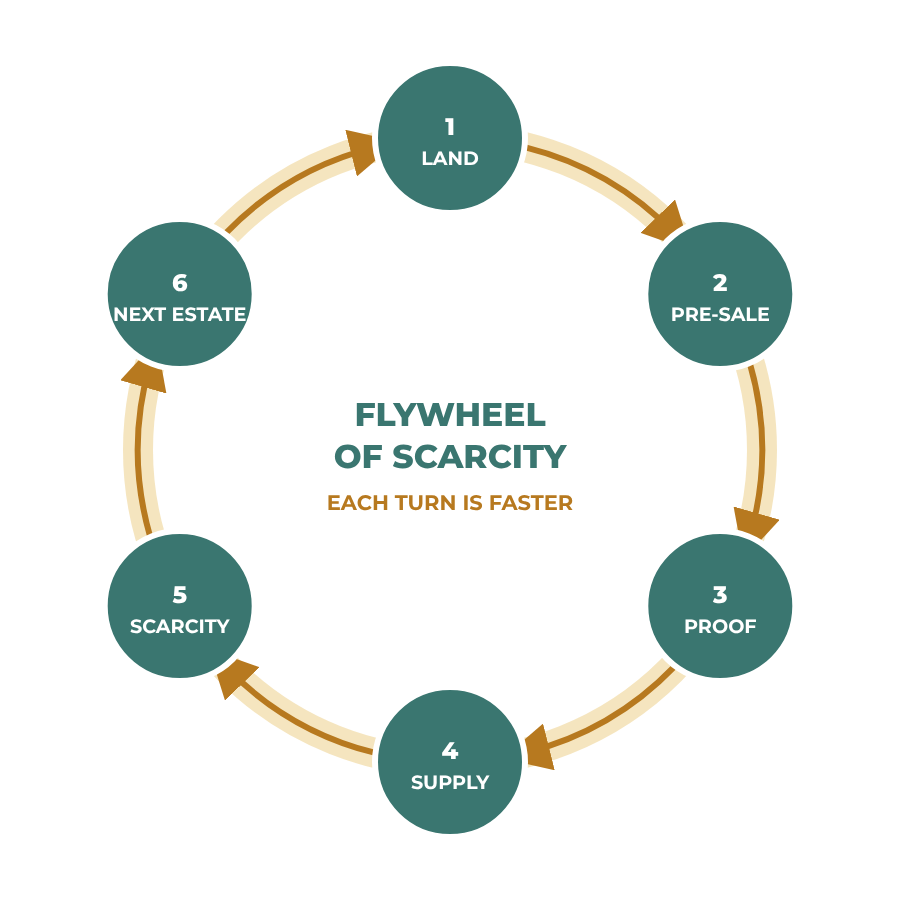
The Flywheel of Scarcity
Durable removal from OECD land is finite: it needs titled land, years of growth and proof that survives audit. mOrganic’s model turns that scarcity into momentum. Landowners contribute land (1). A forward RCRU buyer funds the build before ground is broken (2). FarmChain measures the gain and RCRUs are minted only when verified (3). Buyers lock in long-term supply (4), so fewer tonnes remain for everyone else (5). Each verified estate brings the next landowner to the table, faster (6).
The first buyers set the terms. Those who wait buy what is left.
Why FarmChain and the RCRU meet Scope 3 needs better than the alternatives
| Option | Removal, not avoidance | Measured in the ground, continuously | Traceable to a food supply chain | Delivers food security too | U.S. land and law | Available now at scale |
|---|---|---|---|---|---|---|
| Avoidance offsets (avoided deforestation, cookstoves) | ||||||
| Legacy forestry registries | ||||||
| Direct air capture | ||||||
| Stand-alone biochar | ||||||
| RCRU on FarmChain™ |
strong · partial or varies by project · weak or absent. mOrganic assessment, October 2026. RCRU volumes are scaling from a first estate; supply is limited by design.
For a sovereign fund with food holdings, an RCRU does double duty: it is grown inside a food supply chain you can own, measured to the standard the new GHG Protocol rules demand, and verified independently before it exists. Purchased RCRUs are reported separately from gross emissions, as the GHG Protocol and SBTi require; they address the residual a supply chain cannot cut.
Total Addressable Market: The Scope 3 Carbon-Removal Opportunity
Our report sizes institutional demand for high-integrity, nature-based durable carbon removal across sovereigns, corporates, financial institutions and natural-capital investors.
CLICK HERE TO DOWNLOAD THE TAM SCOPE 3 REPORTLand contributed. Build funded in advance. Profits shared.
mOrganic does not need to buy the world’s farmland to restore it. The landowner joint venture lets families, ranches, nations and Indigenous communities keep title while mOrganic designs, builds and runs the HyperLocal EcoSystem on their land.
Land in
The owner contributes land by long-term lease; title never leaves the owner.
Build pre-funded
A forward RCRU purchase pays for the build and working capital before ground is broken.
Operate and prove
mOrganic runs every revenue stream and offtake; FarmChain measures every acre.
Share and return
Profits are shared once costs are met; the land returns restored, trees in place.
A historic Hawaiʻi Island ranch is the first (announcement pending). The same structure is in discussion with farm owners in Hawaiʻi, California, Portugal, Zimbabwe, Ecuador and Peru, with Kona Hills as the flagship estate that proves the model.
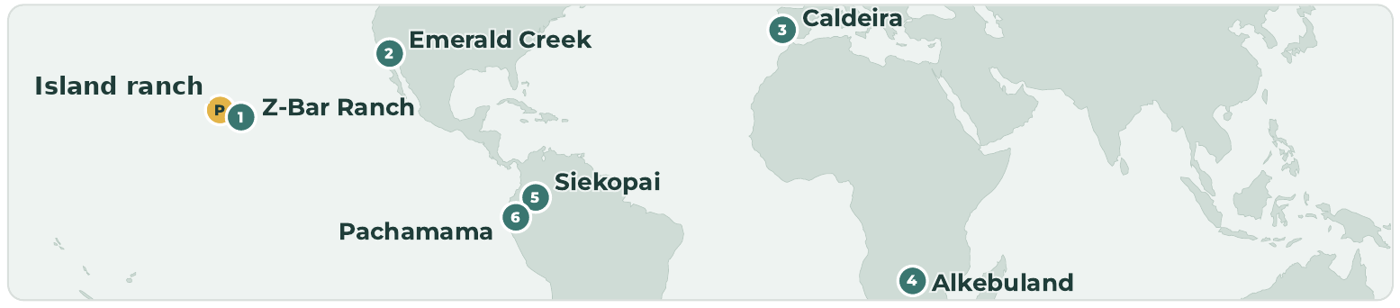
further landowner opportunities beyond the first ranch
acres in discussion across the pipeline
countries on four continents
structure: land contributed, build pre-funded, profits shared
1 Z-Bar Ranch
Waimea paniolo operation; moringa forage for the herd. Proposal and term sheet issued.
2 Emerald Creek Estate
Winery estate; the Quad-Helix adapted to a Mediterranean climate. In discussion.
3 Caldeira Estate
Family cork and stone-pine estate; land stays in family hands. Financial model under review.
4 Alkebuland Studios
Regenerative agroforestry and innovation campus. MOU and NDA signed.
5 Siekopai Nation
Indigenous-led restoration of ancestral territory, measured on FarmChain. In discussion.
6 Pachamama Alliance
Partner territories in the Amazon headwaters. Early discussions.
For a sovereign fund, the model is portable to your own territory. State land banks, national food companies and agricultural development programs can host a HyperLocal EcoSystem under the same structure, growing food for your people at home while the removal unit funds the build.
Own the solution, not the problem
1 RESTORE your nation’s supply. A repeatable model for growing food at home, on your own land, with the build funded by removal buyers rather than your balance sheet.
2 RESTORE your portfolio’s climate position. First call on durable, measured removals from U.S. land for the residual emissions your portfolio companies cannot cut, before the 2027 rules tighten supply further.
3 RESTORE the value of real assets. Working land that produces food, visitors and removals, held in infrastructure-style contracts: an early position in an asset class that does not yet have a name.
4 RESTORE community and legacy. Island schools fed by island food, Indigenous land restored under its own stewards, and a public story your nation will be proud to tell.
Three ways to reserve your place
Genesis RCRU allocation
Forward purchase of RCRUs from Kona Hills and the first joint ventures, at a pre-sale discount to the $195 face value, delivered only as they are minted and verified.
Joint-venture partner
Fund the forward purchase behind a named estate, or bring your own land, food company or development program into the Global Growth Model.
Platform partner
A strategic relationship with mOrganic Holdings, with access to FarmChain, the RCRU platform and the full pipeline, discussed privately under NDA.
When
November 16, 2026: Kona Hills court-supervised sale.
January 1, 2027: GHG Protocol removals standard takes effect.
Now: Genesis allocations are finite and assigned in order of commitment.
How to start
Download the report, then write to us to request the NDA data room. We will hold a 45-minute working session with your team within ten business days.
RESTORE the Land. RESTORE the Supply. RESTORE the Value.
Contact us this week to explore reserving your spot. Kendell Lang, Chairman & CEO · CEO@morganic.ag
CLICK HERE TO DOWNLOAD THE TAM SCOPE 3 REPORTRequest the data room